Your digital shelf data has gaps. We built 12 models to close them.
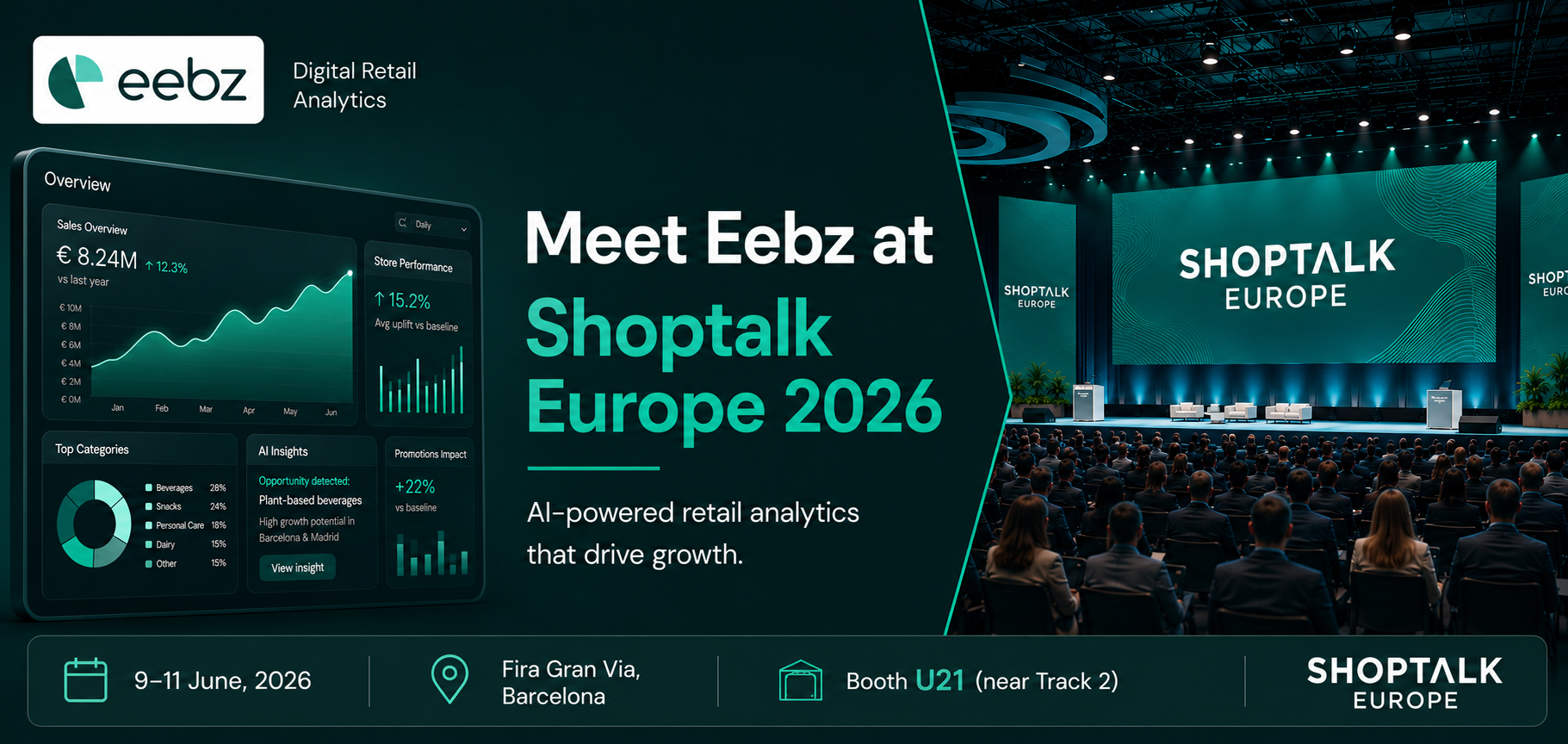
Most DSA tools capture around 30% of a retail category. The gaps aren't bugs - they're structural. We built 12 AI foundation models to close every one of them. We're showing them live at Shoptalk Europe, Barcelona, 9 - 11 June 2026.
There's a moment most digital shelf teams have experienced. You open your dashboard on a Monday morning. The numbers look fine. Market share is steady. Content scores are green. And then your sales director walks in and says a competitor moved hard on three key retailers over the weekend - price drops, new listings, retail media spend - and you're the last to know.
Your data didn't lie. It just had gaps.
Not small gaps either. Most digital shelf analytics tools capture somewhere between 30% and 48% of a retail category. They stop at page one. They miss new listings for days. They treat Size 8 Olive and Size 10 Black as unrelated products. They report on the retailers you already knew about and leave the rest dark.
The gaps aren't a bug. They're structural - built into how first-generation DSA tools were designed.
We built Eebz to close them.
What we're showing at Shoptalk Europe, Barcelona
This June we'll be at Shoptalk Europe (Booth U21, Fira Gran Via, 9 - 11 June 2026), and we're bringing something we think is genuinely different: 12 AI foundation models, each one engineered to remove a structural gap in digital shelf intelligence.
Not features. Not dashboards. Foundation models - specialist AI built specifically for how retail works.
Here's what that means in practice.
The 12 models, and the gaps they close
1. Product Matching
The gap: you have a GTIN. Your retailer has a listing. Connecting them - at scale, across hundreds of retailers, for new products within hours of going live - used to require a team. Our Product Matching model does it automatically. 95% of new listings matched within days.
2. Product Lifecycle
The gap: tools treat every product the same regardless of age. A product launched last week needs daily extraction. A product in its fourth year of back-catalogue does not. Our Product Lifecycle model calculates where every SKU sits in its commercial life and adjusts tracking accordingly - cutting cost without losing coverage.
3. Listing Lifecycle
The gap: a retailer stocks a product, then quietly delists it. Most tools keep scraping a dead page for months. Our Listing Lifecycle model predicts how long each retailer should carry each SKU and stops burning resource on listings that have already gone cold.
4. Product Ranging
The gap: gap alerts. Most DSA tools fire a gap alert every time a product isn't listed somewhere. Half of those alerts are noise - the retailer was never going to stock that product in that market. Our Product Ranging model sets the expected range per SKU per channel, so you only see gaps that actually matter.
5. Category Strategy
The gap: you don't know how broad each retailer's range actually is. Without that context, your market share numbers are wrong and your gap alerts are meaningless. Our Category Strategy model predicts each retailer's category depth - so you know whether a missing listing is an oversight or a strategy.
6. Range - Product - SKU Model
The gap: variants. In consumer electronics, one product might have twelve SKUs. In apparel, a single style might have forty. In FMCG, pack size creates a new SKU that bears almost no resemblance to its parent in a retailer's taxonomy. Our Range - Product - SKU model builds the hierarchy - Range → Product → SKU - so you can finally ask questions like "how is the iPhone 17 range performing?" and get an answer that means something.
7. Market Share Engine
The gap: GfK. Traditional market share data is expensive, delayed, and sampled. Our Market Share Engine calculates live share-of-shelf from the retailer's own taxonomy - updated daily, full category, no panel sampling.
8. Sell-Through Predictor
The gap: EPOS data from retailers arrives late, costs money, and only tells you what already happened. Our Sell-Through Predictor infers retailer sales velocity from publicly observable on-site signals - giving you a forward view before the EPOS data lands.
9. New Product Detection
The gap: you find out about competitor launches when your sales team sees them in a meeting. Our New Product Detection model fires the moment a new product enters a category - days before legacy tools catch up. In consumer electronics, where launch week is everything, that window matters.
10. Self-Correcting Extractor
The gap: retailer sites change. Constantly. Most DSA providers take up to six weeks to fix a broken extractor when a retailer updates their site. We resolve them in 36 hours on average. Our Self-Correcting Extractor detects site changes and re-engineers the extraction configuration automatically.
11. Full Shelf Pagination
The gap: page one. Most tools scrape the first page of a retailer's product listing and call it done. Amazon alone has three different pagination styles. Our Full Shelf Pagination model navigates all of them - so when we tell you your market share, we mean it.
12. Page Conversion Model
The gap: you know what your content score is. You don't know which elements actually drive sales. Our Page Conversion Model weights discoverability signals against commercial outcomes - so you fix what matters, not what's easiest to fix. For the full list of fields worth scoring and how often to check each one, see our shelf audit guide.
You don't have to replace anything
One more thing we hear a lot at shows like Shoptalk: "We already have a data platform. We're not looking to rip and replace."
Fair enough. You don't have to.
Every one of our 12 models can deliver its output as a data feed - directly into your existing PIM, ERP, BI tool or data warehouse. Product Matching data enriching your existing content management system. Pricing signals feeding your existing margin tools. Market share numbers landing in the dashboard your team already opens every morning.
We close the gaps in the data you already have. You keep the systems you already use.
Come and find us at Shoptalk
If you're attending Shoptalk Europe, drop by Booth U21, Track 2 - no appointment needed. Find out more in just 7 minutes: tell us a brand and a retailer, and we'll talk you through how Eebz closes the gaps on your digital shelf - content scores, market share, listing coverage, variant resolution.