Product and listing lifecycle
How Eebz works out where a product is in its commercial life, and where each listing of it is at each retailer.
Every product in Eebz has a lifecycle, and so does every listing of it. The product lifecycle says where the product is in its commercial life. The listing lifecycle says where it is at one retailer, because a retailer with a narrow range moves on from a product sooner than a category champion does.
Product Lifecycle and Listing Lifecycle are two of Eebz's 12 foundation models. Together they decide how each listing is judged and how often Eebz reads it.
Product lifecycle
You set two values on a product:
- Release date: when the product goes on sale
- Lifecycle duration (months): how long it stays on sale before retirement
Eebz works out the current stage from these:
| Icon | Stage | When | What it means |
|---|---|---|---|
| Pre-order | Before the release date | On pre-order, not yet shipping | |
| New release | The first 10% of the lifecycle | Launch period: retailers should be restocking fast | |
| Catalogue | Up to 75% | Core sales period: major retailers usually reorder | |
| Late life | Up to 100% | Mature: retailers are winding down reorders | |
| End of life | Up to 120% | Some stock may remain, but retailers won't reorder | |
| Retired | After 120% | Probably off the shelf |
A product with a 24-month lifecycle is a new release for about its first ten weeks, catalogue until month 18, late life until month 24 and end of life until about month 29. After that it is retired.
A SKU can have its own release date and lifecycle. A SKU without them takes the product's.
Where to set it
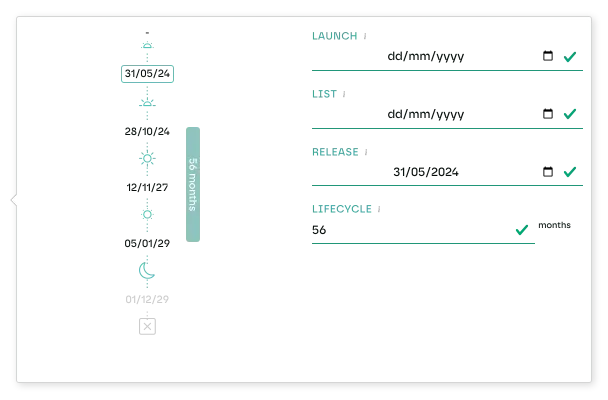
Click the lifecycle date in the Lifecycle section of the product's sidebar. A timeline shows the date each stage begins and how long the lifecycle runs.
Alongside the release date and lifecycle, you can record two dates for reference:
- Launch: when the product is publicly announced. It doesn't affect the lifecycle.
- List: when retailers should list the product. Set it to the release date if you don't want pre-orders.
Lifecycle is a filter across the app: in listings, dashboard cards and Playground reports.
Listing lifecycle
A listing is one SKU at one retailer. Its lifecycle starts from the product lifecycle, and Eebz then adjusts it for two things:
- The product's ranging, from AAA to C
- The retailer's category strategy for that market
At a category champion, an AAA product follows its product lifecycle in full. The narrower the retailer's strategy, and the lower the product's ranging, the shorter the product's life at that retailer: the listing reaches late life and end of life sooner. A product outside the retailer's range has no listing lifecycle there. Exclusive (C) products are the exception: they are listed only where you agreed them, so wherever one is listed it follows its product lifecycle in full.
So ranging changes lifecycle stages. Lower a product from AA to A and its listings age sooner at retailers with narrower strategies, or drop out of their range altogether. Raise it and they stay current for longer.
The icons are the product lifecycle icons standing on a shelf. See the icon key.
To see how a listing's lifecycle was worked out, open the listing and click the lifecycle badge on its image. The Listing Lifecycle Summary shows the listing's stage, its release and expected retirement dates, the retailer's category strategy, the SKU's ranging and the product's current stage.
Effect on extracts
How often Eebz reads a listing depends on its listing lifecycle stage and whether it is in stock. This is the standard schedule:
| Listing stage | In stock | Out of stock |
|---|---|---|
| Pre-order, New release, Catalogue | Daily | Daily |
| Late life | Daily | Weekly |
| End of life | Daily | Every four weeks |
| Retired | Daily | Stops |
Some retailers run to their own schedule. Store extracts run for listings from New release to End of life. Because the schedule follows the listing, a product still in catalogue can be read less often at a retailer where its listing has reached late life.
How lifecycle and ranging work together
Eebz assesses each listing from three things:
- The product's lifecycle stage
- The product's ranging
- The retailer's category strategy for that type of product
An AAA product in its catalogue stage should be stocked by every retailer whose strategy covers it, so a gap is flagged as missing. Rate the same product B and Eebz only expects it at category champions, so its absence elsewhere is not flagged.
That way an out-of-stock or a missing listing is judged in context, not treated the same everywhere.
Last updated November 2026